
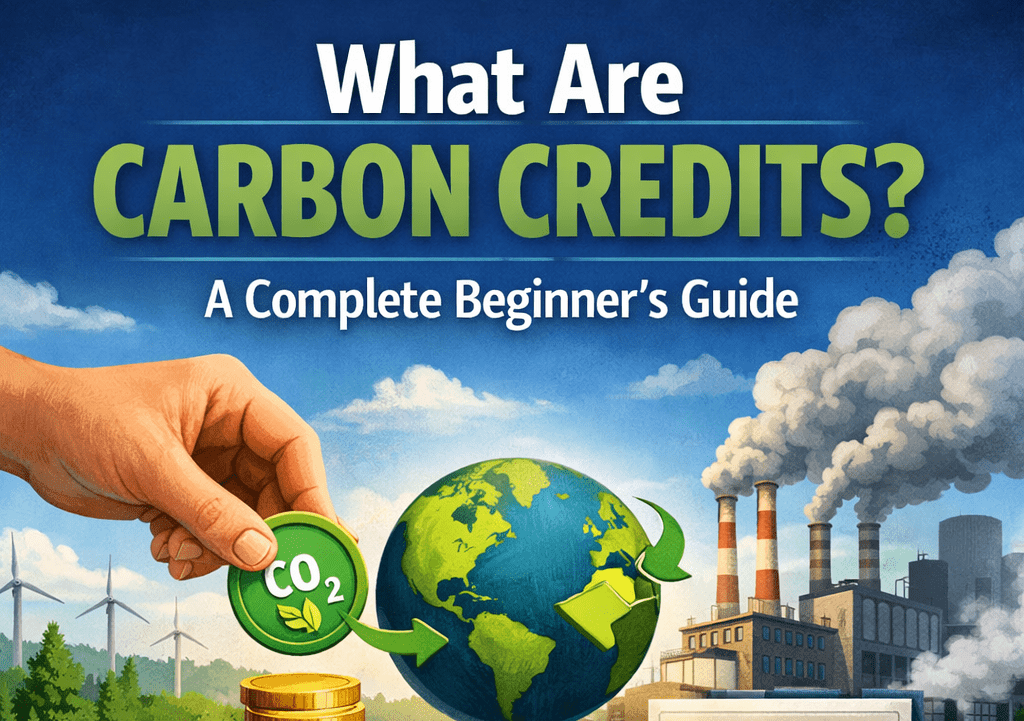
You have probably seen the phrase “carbon credits” pop up in news headlines, corporate sustainability reports, and climate policy debates. But what exactly are carbon credits, and why does everyone seem to be talking about them?
In short, carbon credits are a tool designed to reduce greenhouse gas emissions by putting a price on pollution.
They sit at the center of a global effort to slow down climate change, and they affect everyone from multinational corporations to small farmers in developing countries.
This guide breaks down carbon credits in plain language. No jargon. No economics degree required.
Key Fact: One carbon credit = the right to emit (or the removal of) one metric ton of carbon dioxide (CO₂) or its equivalent in other greenhouse gases.
What Are Carbon Credits, Exactly?
A carbon credit is a tradable permit or certificate.
It represents one metric ton of CO₂ that has either been removed from the atmosphere or prevented from being emitted.
Think of it like a token.
Companies that emit too much CO₂ can buy these tokens to “offset” their pollution.
Companies or projects that reduce or absorb CO₂ can sell these tokens and earn money for their efforts.
The underlying idea is straightforward: make pollution expensive so that reducing it becomes the smart economic choice.
Carbon Credits vs. Carbon Offsets: Are They the Same?
People often use these two terms interchangeably, but there is a subtle difference.
Carbon credits are typically used in regulated (compliance) markets. A government or regulatory body creates them and caps total emissions.
Carbon offsets are usually generated in voluntary markets. A company or individual buys them to compensate for their own emissions, outside of any legal requirement.
In everyday conversation, both terms refer to the same basic concept: a unit representing one ton of CO₂ reduced, avoided, or removed.
How Do Carbon Credits Work?
The carbon credit system works through a simple supply-and-demand mechanism.
Here is a step-by-step breakdown of how the whole process flows.
Step 1: A limit (cap) gets set A government or regulatory body sets a maximum limit on total greenhouse gas emissions for an industry or country. This is the “cap” in “cap-and-trade.”
Step 2: Credits get distributed Regulators issue carbon credits (also called “allowances”) to companies. Each credit allows them to emit one ton of CO₂.
Step 3: Companies emit and track Companies go about their operations. At the end of the year, they must hold enough credits to cover their total emissions.
Step 4: Trading happens Companies that emit less than their cap can sell their leftover credits. Companies that emit more must buy additional credits in the market.
Step 5: The cap shrinks over time Regulators gradually reduce the total number of credits available each year, forcing overall emissions down across the economy.
“Carbon credits turn the atmosphere into a shared resource with a price tag. When pollution costs money, companies have a real incentive to pollute less.”
Types of Carbon Credits
Not all carbon credits are the same. They differ in origin, verification standard, and the type of market they belong to.
1. Compliance Market Credits
These credits exist within government-mandated emissions trading systems (ETS).
Companies in regulated industries must participate.
The most well-known example is the European Union Emissions Trading System (EU ETS), which covers power plants, airlines, and heavy industry across Europe.
2. Voluntary Market Credits
These credits are generated and sold outside of government mandates.
Companies, organizations, or even individuals buy them voluntarily to meet their own sustainability goals or net-zero pledges.
3. Credits by Project Type
- Nature-based: Forest protection (REDD+), reforestation, wetland restoration, and soil carbon sequestration.
- Renewable energy: Wind, solar, hydro, and biomass projects that replace fossil fuel-based electricity generation.
- Industrial efficiency: Capturing methane from landfills, upgrading industrial equipment, and improving energy efficiency.
- Direct air capture: Technology-based removal of CO₂ directly from the atmosphere using machines and chemical processes.
Who Buys and Sells Carbon Credits?
Who Buys Carbon Credits?
- Large corporations trying to meet net-zero commitments (Microsoft, Delta Airlines, Shell)
- Regulated industries that exceed their emissions cap under government rules
- Financial institutions and traders who speculate on carbon credit prices
- Governments that need additional credits to meet international climate targets
- Individuals who want to offset the emissions from flights, events, or daily life
Who Sells Carbon Credits?
- Forestry and land-use projects that protect or restore natural carbon sinks
- Renewable energy developers whose projects reduce reliance on fossil fuels
- Industrial companies that have invested in cleaner technology and have surplus credits
- Agricultural projects that use regenerative farming to store carbon in soil
- Developing-country communities that run clean cookstove or water purification programs
How Much Does a Carbon Credit Cost?
Carbon credit prices vary widely depending on the market, project type, and quality of the credit.
- EU Emissions Trading System (ETS): $60 to $100+ per ton. Regulated, high liquidity.
- California Cap-and-Trade: $30 to $40 per ton. US state-level compliance market.
- Voluntary markets (nature-based): $5 to $50 per ton. Price varies by project quality.
- Voluntary markets (tech-based removal): $200 to $1,000+ per ton. Covers direct air capture, biochar, etc.
- India Carbon Credit Market: ₹250 to ₹800+ per ton. Nascent but growing fast.
Prices fluctuate based on government policy, economic conditions, energy prices, and market demand.
Generally, compliance market credits trade at higher and more stable prices than voluntary market credits.
How Are Carbon Credits Verified?
Not every claim of “we reduced emissions” is trustworthy.
That is why independent verification bodies exist to ensure carbon credits represent real, measurable, and permanent emission reductions.
Major Carbon Credit Standards
- Verified Carbon Standard (Verra / VCS): The world’s most widely used voluntary carbon market standard.
- Gold Standard: Backed by WWF and other NGOs, it focuses on sustainable development co-benefits alongside emission reductions.
- American Carbon Registry (ACR): One of the first voluntary offset programs in the US.
- Climate Action Reserve (CAR): Focuses on North American carbon offset projects.
- CORSIA (ICAO): A global standard specifically for the aviation industry.
The Four Criteria Every Verified Credit Must Meet
- Real: The emissions reduction actually happened.
- Measurable: The reduction can be quantified with scientific accuracy.
- Permanent: The reduction will not be reversed (for example, a forest is not cut down later).
- Additional: The project would not have happened without carbon credit financing.
Do Carbon Credits Actually Work? Criticisms and Controversies
Carbon credits are not without controversy. Critics raise several valid concerns about their effectiveness.
The Greenwashing Problem
Some companies buy cheap, low-quality offsets to claim they are “carbon neutral” while continuing to pollute at the same rate.
A 2023 Guardian investigation found that a significant share of rainforest offset credits approved by Verra did not represent real carbon reductions.
Permanence Risk
A forest that earns carbon credits today might burn down tomorrow due to wildfires or illegal logging.
When that happens, the sequestered carbon returns to the atmosphere and the credit becomes worthless.
Double Counting
A developing country might sell a carbon credit to a foreign corporation.
But then that same country counts the emission reduction toward its own national climate target.
This creates a situation where one ton of CO₂ reduction gets claimed by two parties simultaneously.
The “Distraction” Argument
Some climate scientists argue that carbon credits give companies permission to delay the hard work of actually cutting their own emissions.
They call it a way to “pay to pollute” rather than transform operations.
The consensus among climate experts: Carbon credits can be a useful tool, but only as a supplement to deep, direct emission cuts, not a substitute for them.
Real-World Examples of Carbon Credits in Action
Example 1: Microsoft’s Carbon Removal Strategy
Microsoft has committed to becoming carbon negative by 2030.
The company purchases both nature-based and technology-based carbon credits.
It openly publishes the price it pays per ton and sets quality standards to avoid greenwashing.
Example 2: REDD+ Projects in the Amazon
Indigenous communities in the Brazilian Amazon earn income by protecting their forests from deforestation.
Verified forest protection credits get sold on global markets, giving communities a financial incentive to preserve biodiversity and sequester carbon.
Example 3: India’s Perform Achieve and Trade (PAT) Scheme
India runs one of the world’s largest energy efficiency trading schemes.
Energy-intensive industries that exceed efficiency targets earn tradable certificates they can sell to industries that fall short, creating a domestic carbon-like market.
Example 4: Aviation and CORSIA
Under the Carbon Offsetting and Reduction Scheme for International Aviation (CORSIA), airlines that exceed a baseline emissions level must purchase carbon offsets.
This is one of the most ambitious sector-specific carbon market programs globally.
How Can You Buy Carbon Credits?
Buying carbon credits has become increasingly accessible, even for individuals and small businesses.
For Individuals
- Gold Standard Marketplace (goldstandard.org) allows you to buy certified credits directly.
- Flight booking sites like Lufthansa and Air India now offer carbon offset options at checkout.
- Apps like Klima, Wren, and Terrapass let you subscribe to offset your lifestyle emissions monthly.
For Businesses
- Xpansiv CBL: A major spot market for voluntary carbon credits.
- South Pole / EcoAct / 3Degrees: Carbon credit project developers and brokers.
- Commodity brokers: For compliance market credits in regulated systems like EU ETS.
Before You Buy: A Quick Checklist
- Check that the credit is verified by a recognized standard (Verra, Gold Standard, ACR)
- Look for “additionality” proof (the project would not happen without credit funding)
- Prefer credits with co-benefits such as biodiversity and community development
- Avoid credits that are extremely cheap without explanation
- Confirm the credit has been “retired” (removed from the registry after purchase) to prevent double counting
The Future of Carbon Credits
The carbon credit market is growing fast, but it is also evolving rapidly.
Article 6 of the Paris Agreement
After years of negotiation, countries are now implementing Article 6 of the Paris Agreement, which creates a framework for international carbon credit trading between nations.
This promises to create a more standardized and credible global market.
Technology-Based Removal Credits
Direct air capture, enhanced weathering, biochar, and ocean-based removal are generating a new class of high-quality, durable carbon credits.
These carry higher price tags but offer stronger permanence guarantees.
Blockchain and Transparency
Startups are using blockchain technology to create transparent, tamper-proof registries for carbon credits.
This aims to solve the double-counting and fraud problems that have plagued voluntary markets.
Carbon Border Adjustment Mechanisms
The EU’s Carbon Border Adjustment Mechanism (CBAM), which took effect in 2026, charges importers for the carbon embedded in goods they bring into Europe.
This effectively exports carbon pricing globally and will drive higher demand for quality credits.
Actionable Takeaways
- Calculate your carbon footprint using a free online tool before buying any offsets.
- Reduce first, offset second. Carbon credits should complement emission reductions, not replace them.
- Buy quality credits with verified standards and clear additionality proof.
- Follow the market. Carbon pricing policy is changing fast across Asia, Europe, and the Americas.
- Push for disclosure. Ask any company you work with or invest in to report on how they use carbon credits in their net-zero strategy.
Conclusion
Carbon credits are one of the most widely discussed, and most misunderstood, tools in the global climate toolkit.
At their best, they channel money toward genuine emission reductions and help communities in developing countries earn income from protecting nature.
At their worst, they let polluters buy their way out of responsibility without making real changes.
The key is quality, transparency, and using carbon credits as a bridge to a cleaner world, not as a permanent workaround.
As global regulations tighten and the price of carbon rises, the economic logic will increasingly favor companies that reduce emissions directly rather than offset them indefinitely.
Understanding carbon credits today puts you ahead of a conversation that will only get louder in the years to come.
Frequently Asked Questions (FAQ)
Q: What is one carbon credit worth?
One carbon credit represents one metric ton of CO₂ (or equivalent greenhouse gas) reduced, avoided, or removed. The monetary value varies from as low as $5 for some voluntary offsets to over $100 in regulated compliance markets like the EU ETS.
Q: Are carbon credits a good investment?
Carbon credits can serve as an investment vehicle, but they carry significant regulatory and market risk. Compliance market credits like EU ETS allowances are more liquid and stable. Voluntary credits are riskier and harder to resell. Consult a financial advisor before investing in carbon markets.
Q: How do I know if a carbon credit is legitimate?
Look for credits certified under recognized standards such as Verra (VCS), Gold Standard, or ACR. You should be able to verify the credit’s retirement status in a public registry, which confirms it has not been sold twice.
Q: What is the difference between cap-and-trade and a carbon tax?
A carbon tax sets a fixed price on emissions but does not limit the total amount. Cap-and-trade sets a hard limit (cap) on emissions and lets the market determine the price through trading. Both are carbon pricing mechanisms, but they work differently in practice.
Q: Can individuals buy carbon credits?
Yes. Individuals can buy carbon offsets through platforms like Gold Standard Marketplace, Wren, Klima, and Terrapass. Many airlines and booking apps also offer offset options at checkout. One ton of CO₂ offset typically costs between $10 and $50 for individuals.
Q: Do carbon credits actually reduce global warming?
High-quality, well-verified carbon credits do contribute to reducing global warming by funding real emission reductions and carbon removal. However, their overall impact is limited if companies use them as a substitute for cutting their own emissions rather than a complement to doing so.
Q: What is a carbon credit in simple terms?
In simple terms, a carbon credit is a permission slip that represents one ton of greenhouse gas that has been removed from or kept out of the atmosphere. Companies and individuals can buy these to balance out (offset) their own emissions.
Leave a Reply