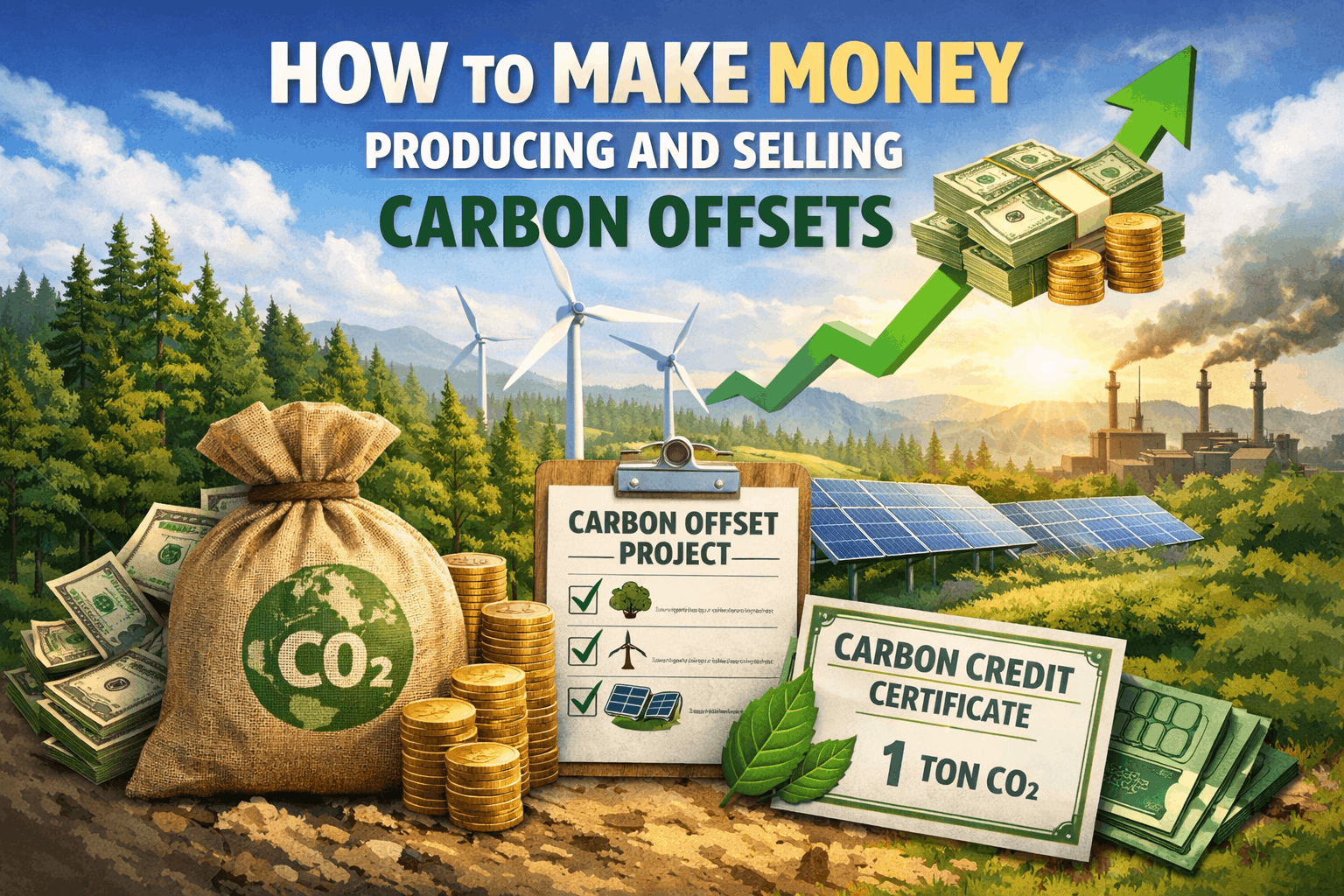
Carbon credits are quietly becoming one of the most interesting income opportunities of the decade.
Companies around the world are under pressure to reduce their carbon footprint.
When they can’t cut emissions fast enough, they buy carbon offsets to compensate.
That demand creates a real market, and someone has to supply it.
That someone could be you.
Whether you own land, run a farm, manage a forest, or simply want to develop carbon projects professionally, there are legitimate ways to produce and sell carbon offsets for profit.
This guide breaks down exactly how it works, step by step, without the jargon.
What Are Carbon Offsets, Really?
A carbon offset represents one tonne of CO2 (or its equivalent) that has been removed from the atmosphere, or prevented from entering it.
When a company buys an offset, they’re essentially paying for that reduction to happen elsewhere, in place of their own emissions.
Offsets are created through carbon projects.
These projects can range from planting trees and protecting forests to capturing methane from landfills or installing clean cookstoves in rural communities.
Once a project is verified and certified, it generates carbon credits that can be sold on the carbon market.
Who Can Produce Carbon Offsets?
More people can participate than you might think.
Landowners and farmers can earn revenue from forests, wetlands, grasslands, and agricultural land by running sequestration projects.
Businesses and industrial operators can develop projects around energy efficiency, methane capture, or renewable energy.
Project developers and consultants can build and manage carbon projects on behalf of landowners or organizations, taking a fee or a share of the credits.
NGOs and community organizations can run carbon projects in developing regions, often with strong social and environmental co-benefits.
The entry point depends on what resources or skills you bring to the table.
How the Carbon Offset Market Works
There are two main markets where offsets are traded.
The Voluntary Carbon Market (VCM) is where companies and individuals buy offsets by choice, driven by sustainability commitments or ESG goals. This is the most accessible market for independent producers.
The Compliance Carbon Market is a government-regulated system where companies are legally required to hold allowances or offsets. Examples include the EU Emissions Trading System (ETS) and California’s Cap-and-Trade Program.
For most new producers, the voluntary carbon market is the starting point.
Demand in the VCM has grown significantly. Industry estimates project the VCM could be worth between $10 billion and $40 billion by 2030, compared to just over $2 billion in 2021.
Types of Carbon Projects You Can Develop
Choosing the right project type is one of the most important decisions you’ll make.
Forestry and Land Use Projects
These are among the most popular and accessible project types.
REDD+ (Reducing Emissions from Deforestation and Forest Degradation) projects protect existing forests from being cut down. They generate credits based on the emissions avoided.
Afforestation and Reforestation projects involve planting trees on previously unforested or deforested land. Credits are issued as trees grow and sequester carbon over time.
Improved Forest Management (IFM) projects involve changing how existing forests are managed to store more carbon.
Agriculture and Soil Carbon projects earn credits by shifting to practices like no-till farming, cover cropping, or rotational grazing that build carbon in the soil.
Renewable Energy and Clean Technology Projects
Solar and wind energy projects in developing countries can generate offsets by displacing fossil fuel-based power.
Clean cookstove projects reduce the use of wood fuel in households, cutting emissions and providing health benefits.
Biogas and biomass projects capture and use organic waste, reducing methane emissions.
Industrial and Waste Management Projects
Landfill gas capture projects collect methane from decomposing waste and either flare it or convert it to energy.
Industrial process improvements and fuel switching can qualify as offset projects under certain methodologies.
Step-by-Step: How to Start Producing Carbon Offsets
Step 1: Identify Your Project Opportunity
Start by assessing what resources you have.
Do you own or have access to forested land? Agricultural land? A facility that produces waste or emissions?
Match your resources to a suitable project type. If you have a farm in Maharashtra (India), soil carbon or agroforestry could be a viable option. If you manage a landfill operation, methane capture is worth exploring.
Step 2: Choose a Carbon Standard
Your project needs to be certified by a recognized carbon standard to generate tradable credits.
The most widely accepted standards in the voluntary carbon market include:
- Verra’s Verified Carbon Standard (VCS), the world’s most widely used voluntary carbon standard
- Gold Standard, known for projects with strong social and environmental co-benefits
- American Carbon Registry (ACR), particularly active in the US market
- Climate Action Reserve (CAR), another US-focused standard with rigorous protocols
- Plan Vivo, often used for smallholder farmer and community-based projects
In India, the Carbon Credit Trading Scheme (CCTS) under the Bureau of Energy Efficiency (BEE) is the emerging domestic framework to watch.
Each standard has specific methodologies for different project types.
You need to pick a standard and a methodology that matches your project before you design it.
Step 3: Conduct a Feasibility Assessment
Before investing time and money, run a feasibility check.
This involves:
- Estimating how many tonnes of CO2 your project can sequester or avoid per year
- Calculating the cost of project development, verification, and ongoing monitoring
- Estimating potential revenue based on current credit prices
- Assessing your ability to meet additionality requirements (see below)
Additionality is the key concept here. It means your project must prove that the carbon reductions would not have happened without the financial incentive from carbon credits. This is one of the most scrutinized aspects of any carbon project.
Step 4: Develop Your Project Design Document (PDD)
The Project Design Document is a formal document that outlines:
- The project boundary and location
- The baseline scenario (what would have happened without the project)
- The methodology being used
- How emissions reductions will be measured, reported, and verified (MRV)
- The project timeline and permanence plan
Most producers work with a carbon consultant or specialized firm to prepare the PDD. This stage is technical but critical.
Step 5: Get Your Project Validated and Registered
Once the PDD is ready, an independent third-party auditor called a Validation/Verification Body (VVB) reviews your project.
They check whether your project design meets the requirements of the chosen standard.
After successful validation, your project gets registered on the standard’s public registry. This is when your project becomes official.
Step 6: Implement the Project and Monitor It
Now the actual work begins.
You implement your project activities, whether planting trees, installing equipment, or changing farming practices.
You also run ongoing monitoring to track how much carbon your project is actually sequestering or avoiding. This data feeds into your verification reports.
Step 7: Verification and Credit Issuance
Every one to five years (depending on the standard and project type), a VVB audits your monitoring data.
If the verification is successful, carbon credits are issued to your account on the registry. Each credit is equivalent to one tonne of CO2.
Step 8: Sell Your Carbon Credits
Once you hold verified credits, you can sell them through several channels.
How to Sell Carbon Offsets
Option 1: Over-the-Counter (OTC) Sales
You sell directly to corporate buyers or brokers who negotiate price and volume bilaterally.
This is the most common route for large-volume sellers. Prices are negotiated, and relationships matter.
Option 2: Carbon Marketplaces and Exchanges
Several online platforms allow you to list and sell carbon credits:
- Xpansiv (CBL) is one of the largest carbon trading platforms globally
- South Pole connects project developers with buyers worldwide
- Gold Standard Impact Marketplace is specific to Gold Standard-certified credits
- ClimateTrade and EcoRegistry also facilitate credit trading
- Markit Environmental Registry supports multiple standards
In India, the domestic carbon credit market under CCTS is expected to create a new exchange-based trading mechanism through the Indian Carbon Market (ICM).
Option 3: Forward Sales Agreements
You can sell future credits before they are issued, giving buyers early access and giving you upfront capital.
This is common in large-scale forestry and land use projects where the development timeline is long.
Option 4: Brokers and Aggregators
Carbon brokers act as intermediaries between producers and buyers.
They take a commission but often have established buyer networks.
Aggregators are useful for small landowners or farmers who produce too few credits individually to attract large buyers.
An aggregator pools credits from multiple producers and sells them collectively.
How Much Money Can You Make?
Prices vary widely depending on the project type, standard, co-benefits, and market conditions.
Here is a rough benchmark of voluntary carbon credit prices:
| Project Type | Approximate Price Range (per tonne CO2) |
|---|---|
| REDD+ / Forest Protection | $5 to $15 |
| Afforestation / Reforestation | $10 to $30 |
| Soil Carbon / Agriculture | $15 to $50 |
| Clean Cookstoves | $15 to $40 |
| Renewable Energy | $3 to $10 |
| Blue Carbon (Mangroves, Wetlands) | $20 to $50+ |
Real-world example: A reforestation project on 500 hectares of degraded land in India might generate around 5,000 to 10,000 tonnes of CO2 per year. At $15 per tonne, that’s $75,000 to $150,000 in annual revenue, before costs.
Project development and verification costs can run anywhere from $50,000 to $200,000 for the initial setup, so you need sufficient scale to make the numbers work.
Smaller producers often enter through aggregation programs, where costs are shared and the barrier to entry is lower.
The Cost Side: What You Need to Budget For
Understanding costs is just as important as projecting revenue.
Project development costs include preparing the PDD, engaging consultants, and initial stakeholder consultations. Expect $20,000 to $100,000 depending on project complexity.
Validation and registration fees vary by standard. Gold Standard and Verra charge registration and issuance fees based on project size.
Monitoring costs are ongoing. You need to track carbon stocks or emissions reductions consistently throughout the project life.
Verification costs occur every time a VVB audits your project, typically every one to five years.
Buffer pool contributions are required by most standards. A percentage of your credits, typically 10 to 20%, are set aside in a buffer pool as insurance against reversal events like wildfires.
Key Risks to Understand
Carbon project development carries real risks.
Reversal risk means the carbon you sequestered could be released back into the atmosphere, for example if a forest burns. This is why buffer pools exist.
Additionality challenges mean your project could fail validation if auditors don’t accept your additionality argument.
Market price volatility means carbon credit prices can drop, affecting your returns.
Regulatory risk is real in a fast-evolving policy landscape. New rules can affect project eligibility or market access.
Long project timelines mean you often wait two to five years before earning your first credit revenue.
Going in with realistic expectations and proper due diligence reduces most of these risks significantly.
Tips for Maximizing Your Carbon Credit Revenue
Choose projects with strong co-benefits. Credits from projects that deliver additional benefits like biodiversity, clean water, or community development often command a premium price. These are called premium or “charismatic” credits.
Select your standard carefully. Gold Standard credits often sell at a higher price than basic VCS credits because of their rigorous co-benefit requirements.
Scale matters. Larger projects generate more credits and attract larger buyers. If you’re a small landowner, consider joining an aggregation program.
Secure offtake agreements early. Locking in a buyer before credits are issued reduces pricing uncertainty and helps you plan cash flow.
Stay current on market trends. The voluntary carbon market is evolving fast. Article 6 of the Paris Agreement, CORSIA (for aviation), and new corporate net-zero frameworks all shape demand and pricing.
Work with experienced consultants. The technical requirements for carbon project development are demanding. A good consultant pays for themselves many times over.
Carbon Offset Opportunities Specific to India
India is emerging as a significant player in the global carbon market.
The Indian Carbon Market (ICM) under the Carbon Credit Trading Scheme (CCTS) is being developed by the Bureau of Energy Efficiency (BEE) and is expected to become operational in full form over the next few years.
Key sectors for Indian project developers include:
- Agroforestry and community forestry across states like Maharashtra, Madhya Pradesh, and the Northeast
- Renewable energy projects replacing coal-based power
- Agricultural soil carbon across major farming states
- Improved cookstove programs in rural households
- Mangrove and wetland restoration in coastal regions
Indian producers can currently access the international voluntary carbon market through Verra and Gold Standard while the domestic market matures.
Internal Linking Suggestions
- Link to your article on “What Are Carbon Credits and How Do They Work” for readers who need foundational knowledge
- Link to your article on “Voluntary Carbon Market Explained” for readers who want deeper market context
- Link to your article on “Carbon Credit Verification Standards Compared” if you have a standards comparison piece
- Link to any course modules covering carbon project development methodology
Ready to explore carbon project development further? Check out our comprehensive Carbon Credit Course for a structured, module-by-module breakdown of how the global carbon market works and how to build a career or business in it.
Conclusion
Making money from carbon offsets is real, but it’s not a shortcut.
It takes genuine effort, the right project design, proper certification, and patience to see returns. The good news is that the market is growing, buyers are willing to pay meaningful prices for high-quality credits, and the tools available to project developers are better than ever.
Whether you are a landowner looking at your forest or farmland differently, a sustainability professional wanting to build projects for clients, or an entrepreneur exploring the green economy, carbon offsets offer a legitimate income stream worth taking seriously.
Start by identifying your project opportunity. Then get the right expertise around you.
The carbon market rewards those who approach it with discipline, not shortcuts.
Frequently Asked Questions
Q: Can individuals make money selling carbon offsets?
Yes. Individuals who own land, forests, or farms can develop carbon projects and earn revenue from verified carbon credits. Smaller producers often work through aggregators.
Q: How long does it take to start earning from a carbon project?
Most projects take two to five years from development to first credit issuance. Fast-track programs and aggregation schemes can reduce this timeline.
Q: What is the minimum land size needed for a carbon forestry project?
Requirements vary by standard and methodology. Some aggregation programs accept plots as small as 5 to 10 hectares, while standalone projects typically require larger land areas to be financially viable.
Q: Is carbon offset production regulated in India?
Yes. The Carbon Credit Trading Scheme (CCTS) and the Indian Carbon Market (ICM) are the domestic regulatory frameworks. Indian developers can also access international voluntary markets through standards like Verra and Gold Standard.
Q: How do I find buyers for my carbon credits?
Options include direct OTC sales to corporates, listing on carbon exchanges like Xpansiv, working with brokers, or using aggregators. Building relationships with buyers or engaging a reputable broker is the most common route for new producers.
Q: Are carbon offsets a reliable long-term income source?
They can be, especially as corporate net-zero commitments grow and regulatory pressure on emissions increases. However, prices fluctuate and project permanence must be actively managed.
Q: What is the difference between carbon offsets and carbon credits?
The terms are often used interchangeably. Technically, a carbon offset refers to a reduction or removal that compensates for an emission elsewhere, while a carbon credit is the tradable unit representing that reduction. In practice, both terms refer to the same tradable instrument.
Leave a Reply