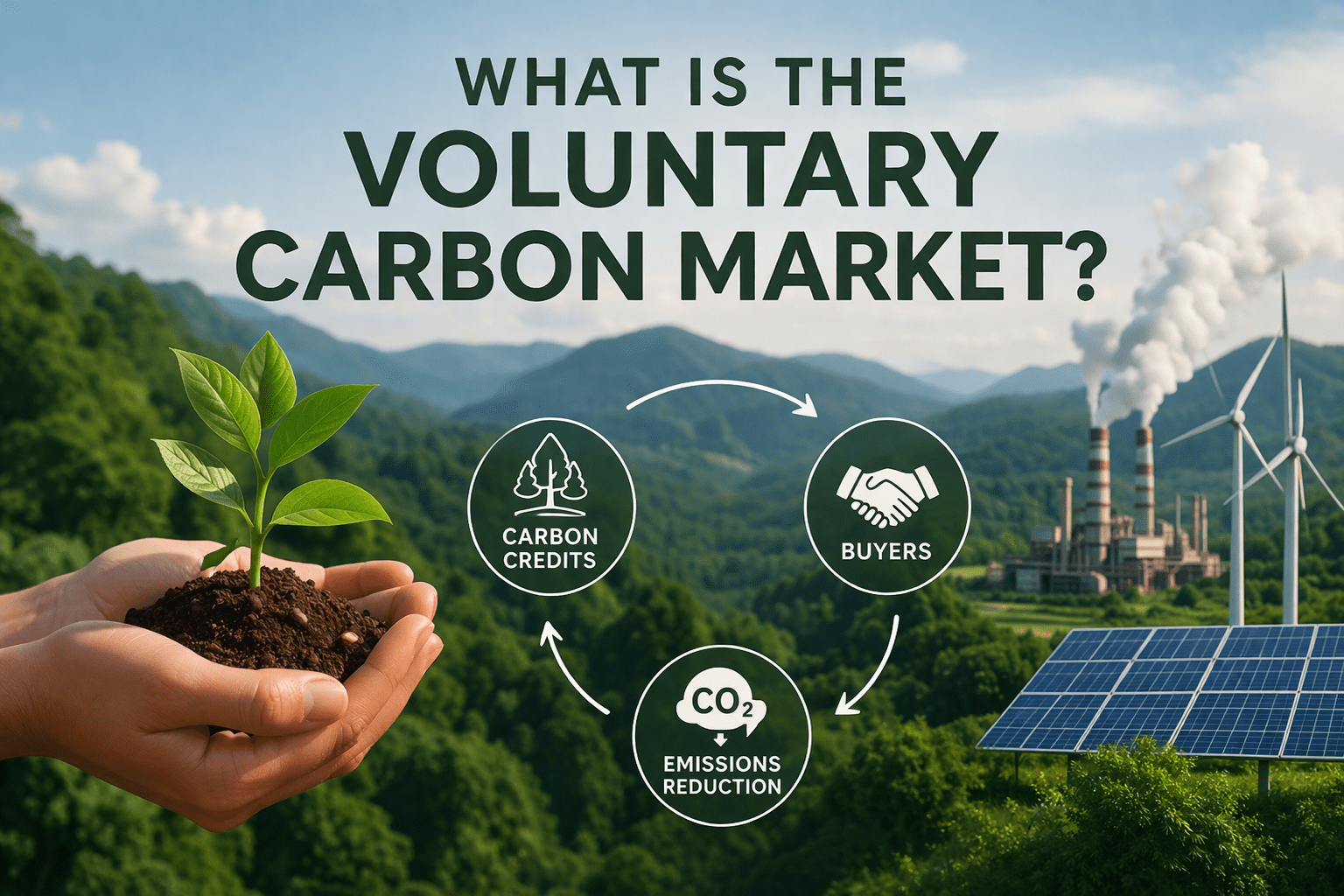
Climate change is the biggest challenge of our generation. And one market quietly working to fight it is the voluntary carbon market.
You may have heard companies say they are “carbon neutral” or “net zero.” Behind many of those claims is the voluntary carbon market doing its work.
In this article, you will learn exactly what the voluntary carbon market is, how it works, who participates in it, and why it matters. No jargon. No fluff. Just clear, practical information.
What Is the Voluntary Carbon Market?
The voluntary carbon market (VCM) is a marketplace where companies, organizations, and individuals voluntarily buy and sell carbon credits to offset their greenhouse gas emissions.
It is called “voluntary” because participation is not required by law.
Businesses choose to participate because of their own climate commitments, sustainability goals, or stakeholder pressure.
Each carbon credit represents the reduction or removal of one metric tonne of carbon dioxide (or its equivalent) from the atmosphere.
When a company buys a carbon credit, it is essentially paying for emission reductions that happened somewhere else in the world, such as a protected forest in Brazil or a clean cooking stove project in Kenya.
Voluntary vs. Compliance Carbon Market: What’s the Difference?
It helps to understand where the voluntary carbon market fits in the broader picture.
Compliance carbon markets are created by government regulations. Companies in regulated industries must buy credits if they exceed their allowed emission limits. The EU Emissions Trading System (EU ETS) is a well-known example.
Voluntary carbon markets operate outside government mandates. Companies participate by choice, driven by their sustainability pledges rather than legal obligations.
Here is a quick comparison:
| Feature | Voluntary Market | Compliance Market |
|---|---|---|
| Participation | By choice | Legally required |
| Buyers | Any company or individual | Regulated industries |
| Standards | Private (Gold Standard, Verra) | Government-set |
| Price | Market-driven, varies widely | Government-influenced |
| Primary goal | CSR and net-zero pledges | Regulatory compliance |
Both markets deal in carbon credits, but they serve different purposes and operate under different rules.
How Does the Voluntary Carbon Market Work?
The voluntary carbon market connects project developers who reduce emissions with buyers who want to offset their own emissions.
Here is how the process works, step by step.
Step 1: A carbon project is developed. A project developer creates an initiative that reduces or removes greenhouse gas emissions. This could be reforestation, renewable energy, methane capture, or improved cookstoves.
Step 2: The project is verified. An independent third party verifies that the project genuinely reduces emissions. Standards like Verra’s Verified Carbon Standard (VCS) or Gold Standard are commonly used.
Step 3: Carbon credits are issued. Once verified, the project receives carbon credits. Each credit equals one tonne of CO2 equivalent reduced or removed.
Step 4: Credits are listed on a marketplace or registry. Credits are recorded on a registry like the Verra Registry or Gold Standard Registry. Buyers can browse and purchase credits from these platforms.
Step 5: A buyer purchases the credits. A company or individual buys the credits to offset their emissions. They can claim that their activities are “carbon neutral” or “carbon offset” for that amount.
Step 6: Credits are retired. Once used, a credit is permanently “retired” so it cannot be sold or used again. This prevents double counting.
Types of Carbon Projects in the Voluntary Market
Not all carbon credits are the same. They come from different types of projects, each with its own method of reducing emissions.
Nature-Based Solutions (NBS) These are projects that protect or restore natural ecosystems.
- Forest conservation (REDD+ projects)
- Reforestation and afforestation
- Mangrove restoration
- Grassland and wetland protection
Renewable Energy Projects These reduce emissions by replacing fossil fuels with clean energy.
- Wind and solar power projects
- Hydropower in developing countries
- Biomass energy from agricultural waste
Methane and Waste Projects These capture or destroy potent greenhouse gases.
- Landfill gas capture
- Coal mine methane recovery
- Agricultural waste biogas projects
Clean Cooking and Community Projects These reduce emissions while improving lives in developing regions.
- Improved cookstove distribution
- Clean water access (reduces boiling fuel use)
- Fuel-efficient brick kilns
Carbon Removal and Technology Projects These are newer project types focused on pulling CO2 out of the atmosphere.
- Biochar application in agriculture
- Direct air capture (DAC) technology
- Enhanced weathering
- Soil carbon sequestration
Who Buys Carbon Credits in the Voluntary Market?
The buyers in the voluntary carbon market are diverse. Here is a breakdown of the main participants.
Corporates with net-zero commitments Large companies like Microsoft, Apple, and Delta Airlines buy carbon credits as part of their climate strategies. They offset emissions they cannot yet eliminate through operational changes.
Small and medium businesses SMEs with sustainability goals or ESG reporting requirements are growing buyers in the market.
Event organizers Conferences, music festivals, and sporting events buy credits to offset the carbon footprint of their events.
Individuals Some people buy credits voluntarily to offset their personal carbon footprints, such as frequent flyers or eco-conscious consumers.
Airlines and travel companies Many airlines offer passengers the option to offset flight emissions at checkout, often through voluntary carbon credits.
Who Sells Carbon Credits?
On the other side of the market, sellers are typically the organizations running carbon reduction projects.
- Project developers who build and manage carbon projects
- Governments of countries hosting projects
- NGOs and conservation organizations
- Farmers and landowners who adopt sustainable land practices
- Aggregators who bundle small projects into tradeable credit portfolios
Key Standards and Registries in the Voluntary Carbon Market
Standards are the backbone of trust in the voluntary carbon market. They set the rules for how projects are designed, verified, and credited.
Verra (Verified Carbon Standard or VCS) Verra is the world’s largest voluntary carbon standard. It runs the Verra Registry, which hosts thousands of projects across the globe.
Gold Standard Founded with WWF support, Gold Standard certifies projects that meet high environmental and social benefit criteria. It is especially strong on community impact.
American Carbon Registry (ACR) One of the oldest voluntary standards in the US, ACR focuses on both domestic and international carbon projects.
Climate Action Reserve (CAR) CAR focuses primarily on North American projects and is known for its rigorous protocols.
Plan Vivo Specifically focused on community-based land use projects in the Global South, Plan Vivo prioritizes smallholder farmers and indigenous communities.
These standards ensure that every credit is:
- Real (the emission reduction actually happened)
- Measurable (it can be quantified accurately)
- Permanent (the reduction will not be reversed)
- Additional (it would not have happened without carbon finance)
- Verified (independently confirmed by a third party)
- Unique (it has not been counted or sold more than once)
How Are Carbon Credit Prices Determined?
Carbon credit prices in the voluntary market vary widely. Unlike compliance markets, there is no single price.
Prices depend on several factors:
- Project type: Removal credits (like direct air capture) are typically more expensive than avoidance credits (like REDD+)
- Co-benefits: Projects with strong social or biodiversity benefits command premium prices
- Vintage: Newer credits are generally more valuable than older ones
- Standard and certification: Credits certified by Gold Standard or Verra with additional labels are priced higher
- Buyer demand: Prices rise during periods of high corporate sustainability activity
As of recent market data, voluntary carbon credit prices have ranged from as low as $3 per tonne for older REDD+ credits to over $100 per tonne for high-quality removal credits like biochar or direct air capture.
Why Does the Voluntary Carbon Market Matter?
The voluntary carbon market is not perfect. But it does some important things that no other mechanism currently does at scale.
It channels money to climate solutions. The voluntary carbon market sends billions of dollars each year to projects that would not otherwise be funded. Forest conservation in Indonesia or clean energy in sub-Saharan Africa gets financed because companies in New York or London are buying credits.
It supports communities in developing countries. Many voluntary carbon projects are in the Global South. They create jobs, improve air quality, protect biodiversity, and build climate resilience in vulnerable communities.
It accelerates corporate climate action. Carbon credits allow companies to take responsibility for their emissions now, while they work on longer-term decarbonization strategies. It bridges the gap between today’s emissions and tomorrow’s technologies.
It helps build the infrastructure for carbon pricing. The voluntary market is developing the standards, data systems, and market infrastructure that governments may eventually adopt in compliance systems.
Criticisms and Challenges of the Voluntary Carbon Market
The voluntary carbon market has faced significant scrutiny. It is important to understand these criticisms honestly.
Greenwashing concerns Some companies use carbon credits as a substitute for actual emission reductions. Buying cheap credits while continuing to pollute is widely criticized as “greenwashing.”
Quality issues with some credits Investigations have found that some carbon credits, particularly from older REDD+ projects, did not deliver the emission reductions they claimed. Over-crediting is a known problem in the market.
Lack of standardization With many different standards and registries, buyers face difficulty comparing the quality of different credits. A $5 credit and a $50 credit might look similar on paper but deliver very different environmental outcomes.
Impermanence risk Forest carbon projects can fail if the forest burns or is illegally logged. When that happens, the carbon previously stored is released back into the atmosphere.
Additionality challenges Proving that a project would not have happened without carbon finance is genuinely difficult. Some projects receive credits for activities that would have happened anyway.
The market is actively working to address these issues through better standards, satellite monitoring, and more rigorous verification.
The Voluntary Carbon Market in India
India is an increasingly important player in the voluntary carbon market, both as a project host and as an emerging buyer.
India hosts a large number of voluntary carbon projects across renewable energy, clean cooking, and forestry.
Many of these projects have been registered under Verra and Gold Standard and have generated millions of credits sold to international buyers.
With India’s new Carbon Credit Trading Scheme (CCTS) framework being developed under the Energy Conservation (Amendment) Act 2022, the line between voluntary and compliance markets in India is beginning to blur.
Indian companies, especially those in energy-intensive sectors, are increasingly participating in the voluntary market as part of their ESG commitments and in preparation for the domestic compliance framework.
How to Buy Carbon Credits in the Voluntary Market
If you are a business looking to offset your emissions through the voluntary carbon market, here is a simple roadmap.
1. Measure your carbon footprint. Before buying credits, understand your emissions across Scope 1, 2, and 3 categories. Use a recognized methodology like the GHG Protocol.
2. Reduce what you can first. Carbon credits should complement emission reductions, not replace them. Offset only what you genuinely cannot avoid.
3. Choose your project type. Decide whether you want nature-based, renewable energy, or removal credits. Consider the co-benefits that align with your company’s values.
4. Verify the standard. Buy only from projects certified by recognized standards like Verra VCS, Gold Standard, or ACR.
5. Purchase through a reputable platform or broker. Platforms like South Pole, Pachama, Xpansiv, and Gold Standard Marketplace are trusted intermediaries.
6. Retire the credits. Make sure the credits are retired in a registry on your behalf. Get a retirement certificate as proof.
7. Communicate transparently. When making carbon neutrality claims, disclose how many tonnes you offset, from which projects, and under what standard.
The Future of the Voluntary Carbon Market
The voluntary carbon market is evolving rapidly. Several trends are shaping its future.
Integrity frameworks are tightening. The Integrity Council for the Voluntary Carbon Market (ICVCM) is developing Core Carbon Principles to set a higher quality threshold for credits. This will weed out low-quality credits and build buyer confidence.
Demand is expected to grow sharply. As more companies adopt science-based net-zero targets, demand for high-quality credits is projected to grow significantly through 2030 and beyond.
Technology is improving transparency. Satellite monitoring, remote sensing, and blockchain-based registries are making it much harder to issue fraudulent or over-counted credits.
Carbon removal will grow in importance. As the world gets closer to 2050 net-zero deadlines, demand for removal credits (which physically pull CO2 from the air) will outpace avoidance credits.
Article 6 of the Paris Agreement will reshape the market. The rules for international carbon trading under Article 6 will create new links between voluntary and compliance markets, potentially transforming how credits flow across borders.
Conclusion: Why the Voluntary Carbon Market Is Worth Understanding
The voluntary carbon market is one of the most dynamic and impactful financial markets you may never have heard of.
It is not perfect. It has faced serious criticism.
But at its best, it moves billions of dollars toward forests, communities, and clean technologies that protect the climate and improve lives.
For businesses in India and around the world, understanding the voluntary carbon market is no longer optional. It is central to credible climate strategy, ESG reporting, and long-term competitive positioning.
Whether you are a business leader, sustainability professional, or simply a curious reader, understanding the voluntary carbon market puts you ahead of most.
Want to go deeper? Explore our full course on carbon markets, covering everything from project development to trading strategies and India’s regulatory framework. It is designed for beginners and professionals alike.
Frequently Asked Questions (FAQ)
What is the difference between a carbon credit and a carbon offset?
The terms are often used interchangeably. A carbon offset refers to the action of compensating for emissions by funding reductions elsewhere. A carbon credit is the tradeable unit that represents that reduction. When you buy carbon credits to neutralize your emissions, you are purchasing carbon offsets.
Is the voluntary carbon market regulated?
No single government body regulates the global voluntary carbon market. It is governed by private standards like Verra and Gold Standard. However, national regulators are increasingly paying attention, and frameworks like India’s CCTS are bringing more structure to the space.
How big is the voluntary carbon market?
The voluntary carbon market reached approximately $2 billion in 2021 and has grown since. Some estimates project it could reach $50 billion or more by 2030 if demand from corporate net-zero commitments materializes.
Can individuals buy carbon credits?
Yes. Individuals can buy carbon credits through platforms like Gold Standard Marketplace, Terrapass, or through airline and travel company offset programs. However, the market is primarily driven by corporate buyers.
Are carbon credits a good investment?
Carbon credits are primarily a climate tool, not a traditional investment vehicle. Their prices are volatile and driven by policy, demand, and project quality. Some investors do trade credits speculatively, but this carries significant risk.
What does “carbon neutral” mean?
A company or activity is carbon neutral when it has measured its total greenhouse gas emissions and offset the equivalent amount through verified carbon credits, resulting in net zero emissions for that period.
What are the best standards for voluntary carbon credits?
The most recognized standards are Verra (VCS), Gold Standard, American Carbon Registry (ACR), and Climate Action Reserve (CAR). For projects with strong community and biodiversity benefits, look for additional certifications like the Climate, Community and Biodiversity (CCB) Standards.
Leave a Reply