
India is one of the fastest-growing economies in the world.
But that growth comes with a cost: rising greenhouse gas emissions that are pushing the planet toward dangerous climate change.
Carbon credits are one of the most practical tools available right now to slow that down and even profit from doing so.
Whether you are a student, a business owner, a sustainability professional, or just someone curious about green finance, this guide will walk you through everything you need to know about carbon credits in India.
Let us start from scratch.
What Is a Carbon Credit?
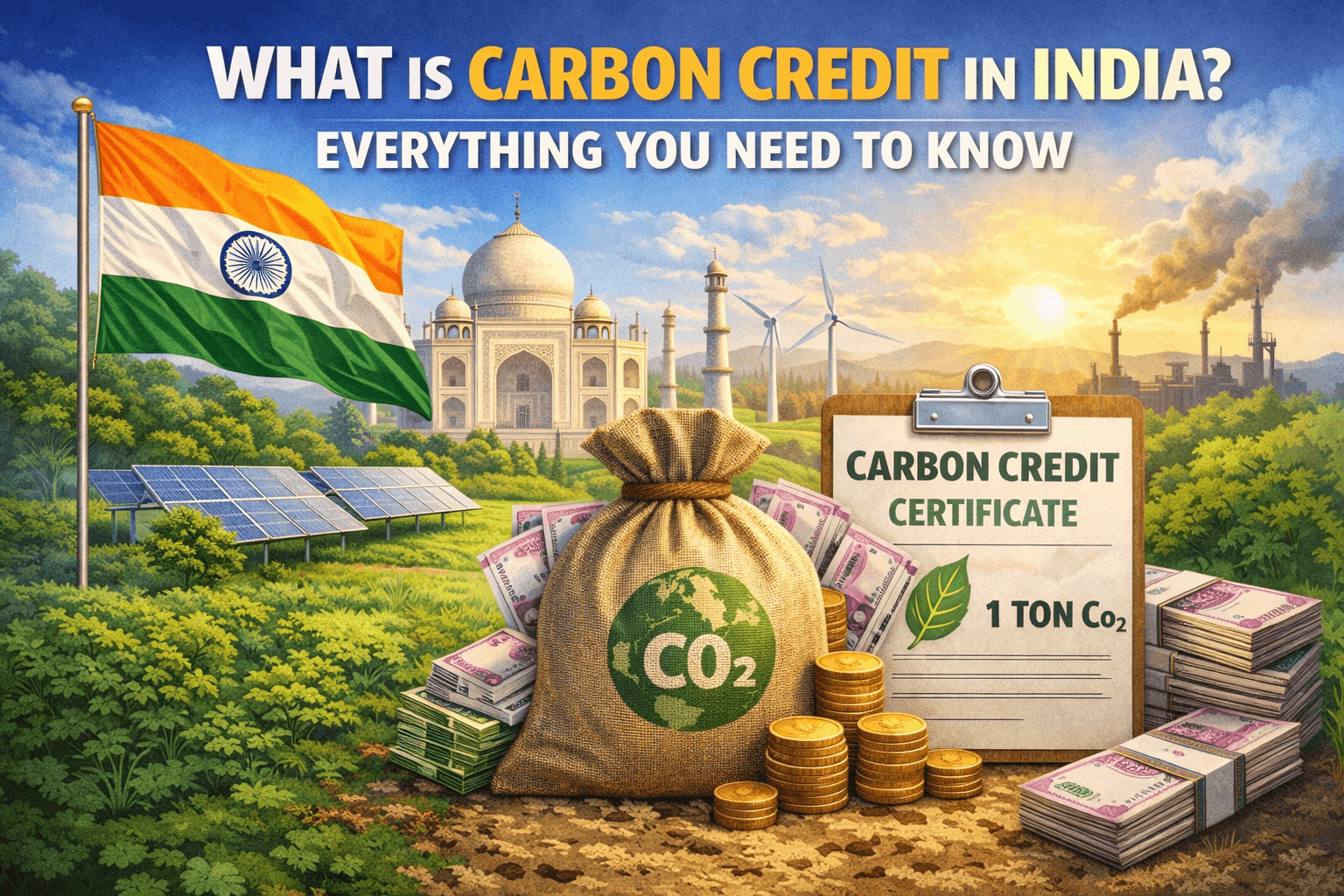
A carbon credit is a permit that represents one metric tonne of carbon dioxide (CO2) removed from or prevented from entering the atmosphere.
Think of it as a unit of climate action.
If a company or project reduces or avoids one tonne of CO2 emissions, it earns one carbon credit.
That credit can then be sold to another company that is struggling to reduce its own emissions.
This creates a financial incentive to cut pollution. The cleaner you operate, the more credits you earn, and the more money you can make.
Why Carbon Credits Matter in India
India is the third-largest emitter of greenhouse gases globally.
At the same time, it has made bold climate commitments through the Paris Agreement, promising to reduce the carbon intensity of its GDP by 45% by 2030 compared to 2005 levels.
Carbon credits help India bridge the gap between where it is and where it needs to be.
They channel private money into clean energy, afforestation, sustainable agriculture, and energy-efficient projects across the country.
For Indian businesses, carbon credits are no longer just an environmental concept. They are becoming a serious financial instrument.
How Do Carbon Credits Work?
The mechanism behind carbon credits is actually straightforward.
Here is the basic flow:
- A project reduces emissions. For example, a solar farm in Rajasthan displaces coal-fired electricity.
- The reduction is measured. A certified auditor calculates exactly how many tonnes of CO2 were avoided.
- Credits are issued. One tonne avoided equals one carbon credit.
- The credits are sold. Another company buys these credits to offset its own emissions.
- The credit is retired. Once used, the credit is permanently cancelled so it cannot be counted twice.
This entire cycle runs through a regulated or voluntary system, depending on the type of carbon market involved.
Types of Carbon Markets in India
India operates across two distinct types of carbon markets.
1. Compliance Carbon Market (Mandatory)
This market is for businesses that are legally required to limit their emissions.
India’s compliance market is driven by:
- The Perform, Achieve and Trade (PAT) Scheme under the Bureau of Energy Efficiency (BEE)
- The upcoming Carbon Credit Trading Scheme (CCTS), India’s first formal compliance carbon market being established under the Energy Conservation (Amendment) Act 2022
Under PAT, energy-intensive industries like cement, steel, and textiles receive energy efficiency targets. If they overperform, they earn Energy Saving Certificates (ESCerts), which they can trade.
The CCTS will take this further by formally linking it to carbon credits under a national framework.
2. Voluntary Carbon Market (Optional)
This market is for companies and individuals who want to offset their emissions voluntarily, often to meet ESG goals or corporate sustainability targets.
Indian projects registered on global platforms like Verra (VCS), Gold Standard, and Plan Vivo generate voluntary carbon credits sold to buyers worldwide.
India is one of the top suppliers of voluntary carbon credits globally.
India’s Carbon Credit Trading Scheme (CCTS) Explained
The CCTS is India’s most significant step toward a formal, government-backed carbon market.
Introduced through the Energy Conservation (Amendment) Act 2022, it sets the legal foundation for carbon credit trading in the country.
Here is what you need to know about CCTS:
- The Bureau of Energy Efficiency (BEE) is the administrator
- The Central Electricity Regulatory Commission (CERC) oversees trading on power exchanges
- Sectors covered include energy-intensive industries like aluminium, iron, steel, cement, pulp and paper, petrochemicals, and textiles
- Companies that exceed their emission reduction targets earn carbon credit certificates
- Companies that fall short must buy credits from overperformers
The CCTS is still being rolled out in phases, but it signals that India is serious about building a robust domestic carbon market.
What Projects Generate Carbon Credits in India?
Many types of projects in India can generate carbon credits.
Here are the most common ones:
Renewable Energy
- Solar power plants
- Wind energy farms
- Small hydropower projects
- Biomass energy
Forestry and Land Use
- Afforestation and reforestation programs
- Community forest management
- Mangrove restoration
Agriculture
- Methane capture from paddy fields
- Improved livestock management
- Biochar application in soils
Industrial Efficiency
- Energy efficiency upgrades in factories
- Waste heat recovery systems
- Fuel switching from coal to cleaner alternatives
Waste Management
- Landfill gas capture
- Composting programs
- Wastewater treatment
India has a massive natural advantage in forestry and solar-based carbon projects, especially in states like Madhya Pradesh, Chhattisgarh, Rajasthan, and Gujarat.
How Much Is a Carbon Credit Worth in India?
Carbon credit prices vary widely depending on the market, project type, and quality of the credit.
In the voluntary market:
- Low-quality credits can trade as low as $1 to $3 per tonne
- High-quality credits with strong co-benefits (biodiversity, community development) can fetch $10 to $50 or more per tonne
In the compliance market (PAT/ESCerts):
- ESCerts have historically traded between Rs. 200 to Rs. 2,000 per unit on the Indian Energy Exchange (IEX)
As India’s CCTS matures and global carbon prices rise, domestic credit values are expected to increase significantly over the coming years.
How Can Indian Companies Earn Carbon Credits?
If you represent an Indian business and want to earn carbon credits, here is how the process works:
Step 1: Identify an eligible activity Pick a project activity that reduces or removes emissions, such as installing solar panels, planting trees, or upgrading industrial equipment.
Step 2: Choose the right standard Depending on your market, register under Verra VCS, Gold Standard, or India’s domestic CCTS framework once fully operational.
Step 3: Prepare a Project Design Document (PDD) This is a detailed document that explains what your project does, how it reduces emissions, and which approved methodology it follows.
Step 4: Get third-party validation An accredited auditor reviews and approves your PDD before you can register the project.
Step 5: Monitor and verify After your project starts, you regularly track emission reductions and get them verified by an independent body.
Step 6: Receive and sell credits Once verified, credits are issued to your account and you can sell them on a carbon exchange or directly to buyers.
This process takes time and has costs involved, but for larger projects, the returns can be substantial.
How Can Individuals Participate in India’s Carbon Market?
You do not need to own a factory to participate in the carbon market.
Here is how everyday Indians can get involved:
- Buy carbon offsets to neutralize your personal carbon footprint from flights, electricity use, or lifestyle emissions
- Invest in carbon credit funds or ESG-focused mutual funds and ETFs that include carbon market exposure
- Work in the carbon market as a project developer, verifier, consultant, or sustainability analyst
- Support community projects that generate carbon credits for smallholder farmers and tribal forest communities
The Indian carbon market is still young, which means early movers have a significant advantage.
India’s Role in the Global Carbon Market
India is a powerhouse in the global voluntary carbon market.
It consistently ranks among the top five countries in terms of registered CDM (Clean Development Mechanism) and VCS projects.
Some key facts:
- India has registered over 1,500 CDM projects historically under the UNFCCC
- Indian projects generate millions of carbon credits annually
- States like Himachal Pradesh, Karnataka, and Tamil Nadu lead in renewable energy credits
- Tribal and indigenous communities in Odisha and Jharkhand are participating in forestry-based credit programs
With the Paris Agreement’s Article 6 enabling international carbon trading, India is positioned to become a major carbon credit exporter.
Key Regulators and Bodies in India’s Carbon Market
Understanding who governs what helps you navigate the system better.
| Body | Role |
|---|---|
| Ministry of Power | Oversees the CCTS framework |
| Bureau of Energy Efficiency (BEE) | Administers the carbon credit registry |
| Central Electricity Regulatory Commission (CERC) | Regulates trading on exchanges |
| Indian Energy Exchange (IEX) | Platform for trading ESCerts and carbon credits |
| Ministry of Environment, Forest and Climate Change (MoEFCC) | Policy oversight and UNFCCC liaison |
Challenges Facing India’s Carbon Market
India’s carbon market has enormous potential, but it also faces real hurdles.
Awareness gap: Most small and medium businesses do not understand carbon credits or how to access the market.
High transaction costs: Verification and registration fees can be prohibitive for smaller projects.
Lack of standardization: Multiple standards and platforms create confusion for buyers and sellers.
Greenwashing risk: Some credits in the voluntary market lack rigorous verification, reducing buyer trust.
Slow regulatory rollout: The CCTS is still being finalized, creating uncertainty for businesses planning long-term investments.
These challenges are solvable, and India is actively working on all of them.
The Future of Carbon Credits in India
The carbon credit market in India is on the edge of a major transformation.
Here is what to watch for:
- Full operationalization of the CCTS by 2026-2027, covering more sectors over time
- Integration with international markets under Paris Agreement Article 6
- Rising carbon prices as global demand for high-quality credits outpaces supply
- Technology-driven monitoring using satellite data, IoT sensors, and blockchain for verification
- Increased retail participation through carbon credit investment platforms aimed at individuals
India has set ambitious renewable energy targets: 500 GW of installed capacity by 2030.
Every gigawatt of clean energy built is a potential source of carbon credits.
The market is only going to grow from here.
Carbon Credits vs. Carbon Tax: What Is the Difference?
Many people confuse these two.
Carbon Tax: The government charges a fixed price per tonne of CO2 emitted. Companies pay it regardless of how much they reduce.
Carbon Credits: Companies are given emission limits. Those who go below the limit earn credits. Those who exceed it must buy credits. The price is set by the market.
Carbon credits reward performance. Carbon taxes penalize emissions.
India currently uses elements of both, but the CCTS signals a clear shift toward a market-based, performance-driven system.
Conclusion
Carbon credits in India are no longer a niche concept reserved for environmental experts.
They are becoming a core part of how Indian businesses operate, how the government meets its climate goals, and how investors generate returns while making a difference.
Whether you want to earn carbon credits through your business, invest in the growing carbon economy, or simply understand the system driving India’s green transition, the time to learn is now.
India’s carbon market is young, fast-moving, and full of opportunity.
The companies and professionals who understand it today will be the ones leading it tomorrow.
Frequently Asked Questions (FAQ)
Q1. What is a carbon credit in simple words?
A carbon credit is a certificate that represents one tonne of CO2 reduced or removed from the atmosphere. It can be bought and sold between companies.
Q2. Is carbon trading legal in India?
Yes. Carbon trading is legal in India. The Energy Conservation (Amendment) Act 2022 established the legal framework for the Carbon Credit Trading Scheme (CCTS).
Q3. How do I earn carbon credits in India?
You can earn carbon credits by implementing projects that reduce emissions, such as renewable energy, afforestation, or energy efficiency upgrades, and getting them verified under an approved standard.
Q4. What is the price of one carbon credit in India?
Prices vary. In the voluntary market, credits range from $1 to $50+ per tonne depending on quality. ESCerts under the PAT scheme have traded between Rs. 200 and Rs. 2,000 per unit.
Q5. What is the difference between ESCerts and carbon credits?
ESCerts (Energy Saving Certificates) are issued under India’s PAT scheme for energy efficiency improvements. Carbon credits are issued for emission reductions more broadly. The CCTS aims to eventually integrate both under one framework.
Q6. Can individuals buy carbon credits in India?
Yes. Individuals can buy carbon offsets from platforms like ClimatePartner, South Pole, or Indian providers to neutralize their personal carbon footprint.
Q7. Which sectors are covered under India’s CCTS?
The CCTS initially covers energy-intensive sectors including aluminium, iron and steel, cement, pulp and paper, petrochemicals, chlor-alkali, and textiles.
Want to go deeper into the world of carbon credits?
Explore our full carbon credit course designed for beginners, professionals, and businesses looking to enter India’s growing carbon market.
Start learning today and get ahead of one of the most important financial and environmental shifts of our generation.
Leave a Reply